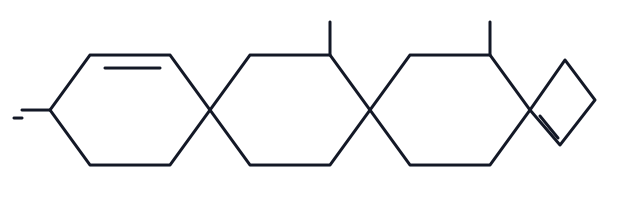
The first time pheromone science stopped being theory for me, I was standing in a corner at a friend’s loft party. I had dabbed a single drop of an androstadienone blend on my collarbone an hour earlier. A woman I had never met walked over, tilted her head, and said, “You smell like something I want to remember.” No pickup line. No flirty preamble. Just a sentence that did not match anything I had earned that night.
I went home and read papers until three in the morning. That was years ago. I have not stopped reading them since.
Here is the thing about pheromone science. Most of what is online is wrong, oversimplified, or pulled from a single 1991 paper that was already shaky when it was published. The real research is messier, more interesting, and more useful. Let me walk you through what I have learned, what Garry at Liquid Alchemy Labs and I argue about over the workbench, and what the last two decades of human chemosignaling work actually tell us.
What a pheromone actually is (and why “smell” is the wrong frame)
A pheromone is a chemical signal one organism releases that triggers a behavioral or physiological response in another organism of the same species. That is the textbook definition from Karlson and Lüscher, 1959. It says nothing about smell.
That distinction matters. Pheromones are not perfume. You can react to them without consciously smelling anything. Some are processed by the olfactory bulb. Others bypass it. In humans the pathways are still debated. The point is that “does it smell good” is the wrong question. The right question is “does the molecule reach the right receptors and trigger the right response.”
When I explain this to a new customer who has just opened a bottle of A1 and is sniffing it like a cologne, I tell them to stop. The signal is doing its job whether your nose catches it or not.
The molecules that matter in pheromone research
There are maybe a dozen molecules that show up over and over in human chemosignaling studies. A few of them are doing most of the work.
Androstadienone (A1). Found in male sweat and saliva. The most-studied human putative pheromone. Linked to mood shifts in women, cortisol modulation, and increased perceived attractiveness in several trials. I wrote a deep piece on the effects of androstadienone and a follow-up on the specific effects of androstadienone on women if you want the citations and the dosing details.
Androstenone. Found in male sweat in higher concentrations. Drives dominance perception. Can read as aggressive at high doses, which is why ratio matters. I unpacked the difference in my piece on androstenone vs androstenol.
Androsterone. A softer, more approachable masculine signal. Reads as reliable rather than threatening. Pairs well with A1.
Copulins. Vaginal fatty acid blends shown to alter male testosterone in some lab settings. Almost zero published work on synthetic copulin colognes despite what the marketing says.
Hedione. Technically a fragrance ingredient, but Wedekind’s group in Geneva showed it activates the human VN1R1 receptor. That is a real receptor doing real work. I covered the full picture in what is hedione.
There are others. Estratetraenol, androstadienol, various 16-androstenes. But if you understand the five above, you understand 90 percent of the field.
Why the science was buried for 30 years
Here is the part nobody tells you. Human pheromone research was treated as fringe for most of the late 20th century. The reason is not what you think.
In the 1990s researchers got obsessed with the vomeronasal organ, the VNO, which rodents use for pheromone detection. They could not find a working VNO in adult humans. So the conclusion in a lot of papers was “humans do not have pheromones.” That was a category error. It is like saying cars do not have engines because you cannot find a horse under the hood.
The field went quiet. Then around 2014, the molecular work caught up. Researchers found human-expressed trace amine receptors and VN1R-family receptors in the main olfactory epithelium. Wedekind, Saxton, Lundström, and others published trial after trial showing that androstadienone exposure produced measurable shifts in mood, attention, and partner perception in women, plus cortisol and testosterone shifts in men. The pathway was not the rodent VNO. It was something else. The signal was real.
So when someone tells you “science proved humans do not have pheromones,” they are quoting a 1990s talking point that the actual literature moved past more than ten years ago. Garry and I were arguing about this just last month while he was rebalancing a batch. The molecular evidence is there. The behavioral evidence is there. The pop-science consensus is just lagging.
I am not going to pretend everything is settled. The terminology is still contested. Some researchers prefer “chemosignal” over “pheromone” because the strict 1959 definition requires a hardcoded species-wide response, which humans do not have for any single molecule. That is a fair distinction. But the practical question of “do these molecules change how people perceive each other” has been answered. The answer is yes, in specific contexts, with measurable effects.
What people online are getting wrong
The myths I see most:
- “Pheromones make you irresistible to anyone.” No. They modulate perception in specific directions. They do not override personality, looks, or social context.
- “If pheromones worked, everyone would use them.” Most people have never heard of human pheromones beyond a 30-second TV segment. Awareness is not adoption.
- “Pheromones only work on women.” False. Estratetraenol affects men. Copulins affect men. Andro compounds affect both sexes in different ways.
- “Cologne pheromones are a scam because they have no smell.” Wrong frame. Most pheromone products are paired with a fragrance carrier specifically because the active molecules work below conscious detection.
I have answered most of these in my standalone piece, do pheromones really work. The short version is that effect sizes are real but modest, context-dependent, and dose-sensitive.
What pheromone research actually shows can happen
Here is what the strongest human chemosignaling trials have demonstrated, with appropriate hedging.
Mood lift in women exposed to androstadienone, particularly in social settings with attractive men present. This is one of the most-replicated findings in the field.
Increased eye contact and perceived friendliness in men wearing andro blends. Saxton’s 2008 speed-dating study is the cleanest demonstration I know of.
Cortisol modulation in women exposed to male chemosignals. Effect is small but reproducible.
Shifts in mate-choice signaling related to MHC-similarity, the Wedekind sweaty t-shirt study from 1995, which still holds up.
Social-warmth and approachability shifts in mixed andro-plus-copulin blends, though this work is mostly anecdotal and forum-driven rather than lab-confirmed. I dug into the social-signal angle in social pheromones.
That is the honest map. Not magic. Not nothing. A real lever that works when you stack it with the rest of your life. The cologne is one variable. Sleep, training, posture, voice, and grooming are others.
If you are coming to this fresh, start with the andro pieces above and the hedione breakdown. Then look at the alpha-dream and L2K context piece for the forum history that shaped the modern formulations. From there, the buying-guide territory will make a lot more sense.
Frequently asked
What is the strongest evidence that human pheromones exist? ▾
The strongest evidence is the replicated effect of androstadienone on female mood, cortisol, and social attention across multiple lab groups since the early 2000s. Wedekind's MHC mate-choice work from 1995 also remains a foundational finding. Effects are modest but real and dose-sensitive.
Are androstadienone and androstenone the same thing? ▾
No. Androstadienone (A1) is associated with softer mood and attention effects in women. Androstenone reads as more dominant and can come across as aggressive at high doses. The two molecules show different perceived-trait profiles in human trials.
Why did scientists say humans do not have pheromones? ▾
In the 1990s, researchers could not find a functional adult human vomeronasal organ, which rodents use for pheromone detection. They wrongly assumed humans had no pheromone pathway at all. Later work found receptors in the main olfactory epithelium, and the field has since reversed that conclusion.
Do pheromones work on gay men or in same-sex contexts? ▾
Yes. Androstadienone shows hypothalamic activation in gay men similar to the pattern seen in straight women, per Savic's 2005 brain-imaging work. Pheromone response tracks attraction orientation rather than biological sex alone.
Can pheromones override looks or personality? ▾
No. Pheromones are a modulator, not a replacement. They shift how you are perceived within a range that your appearance, voice, posture, and social behavior set. Stacked with self-improvement, they are useful. Used as a shortcut around the rest, they will disappoint you.
How long do pheromone effects last after application? ▾
Most andro compounds remain active on skin for four to eight hours, with peak activity in the first two. Hedione tends to fade faster. Reapplication mid-evening is common practice among experienced users.
Is there a difference between natural and synthetic pheromones? ▾
Chemically the synthetic andro compounds are identical to the natural ones. The difference is dose and consistency. Natural body output varies wildly with diet, sleep, and stress. A formulated product gives you a stable signal.
What is the best-studied human pheromone molecule? ▾
Androstadienone, by a wide margin. It has more peer-reviewed trials than any other candidate human pheromone, with documented effects on mood, attention, cortisol, and partner perception in women.
Do pheromones affect testosterone in men? ▾
Some studies, particularly on copulin exposure, show transient testosterone elevation in men. The effect is short-lived and context-dependent. Do not expect a clinical dose response. Expect a small situational lift.
Where should I start if I am new to pheromone science? ▾
Start with the androstadienone explainer and the androstenone-versus-androstenol piece linked above. Those cover roughly 80 percent of what you need to evaluate any product you encounter. The buying decisions get clearer once the molecules make sense.
Articles in this topic
What Is Hedione? The Pheromone-Like Note in Perfume (And What It Does to Women)
Hedione is the perfume note that activates a pheromone receptor in women's brains. Here's what the science actually shows, and why androstenone outperforms it for real attraction.
What Happened to Alpha Dream Pheromones? The L2K Legacy Lives On
Alpha Dream Pheromones is gone. Here's what L2K actually felt like to wear, why the community still talks about it, and the formula that took its place.
Social Pheromones: What They Are, How They Work, and Why They Matter
Social pheromones like androstenol create warmth, trust, and approachability, not just attraction. Here is what the science says and how to actually use them.
Androstadienone: What This Male Pheromone Does (And Why It Matters)
Androstadienone (A1) is the most-studied male pheromone. I cover the mechanism, the women-specific research, dose-response, and what it feels like on real skin.
Androstenone vs Androstenol: Which Pheromone Actually Works Better?
Androstenone vs androstenol explained from someone who has tested both for years. What each molecule signals, when each one works, and how to pick the right side of the line.
Do Pheromones Really Work? The Honest Truth From Someone Who's Tried Them
The science is messy, the marketing is hype, but here's what 6 years of testing pheromone cologne taught me about what actually works and what doesn't.
How to Increase Your Natural Pheromones: Become Magnetic
Sleep, training, diet, stress, skin. The full lifestyle stack I run to crank up natural pheromone output before any bottle hits my skin.