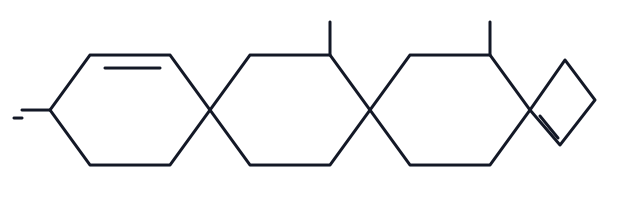
What Pheromones Smell Like: The Honest, Molecule-by-Molecule Answer
What do pheromones smell like? Musky to some, like nothing to others. I break down how androstenone, androstenol, and copulins actually smell, and why they read so differently person to person.
Someone leans close and you catch something warm and faint. It is almost skin-like. You cannot name it, but you notice it. That is usually what pheromones smell like in the real world. Not perfume-loud. Just something quieter and harder to place.
I have sat with this question for years. The honest answer is that it depends on the molecule. It also depends on your own genes, at least as much as the molecule does. That is not a dodge. It is the real answer, and I will give you the whole thing.
A Faint, Warm Musk Is the Closest Honest Description
If I had to pick one description, I would say faint, warm, and a little animal. It is closer to a feeling than a smell.
The best comparison I have is clean skin after a walk in mild weather. It is not sweat. It is something body-warm and organic. Pleasant in that same way, and just as hard to place.
When these compounds are dosed right, people nearby pick up something warm and appealing. They do not register a chemical. They just think that person smells good, or clean, or interesting. They usually cannot say why.
That is the whole point. The signal is quiet on purpose. It runs under the radar of what you would call a smell. Crank the dose way up and some of these do get easy to detect. Good formulas are never built that way.
Why You Barely Register Pheromones as a Smell
In most mammals, pheromones get picked up by the vomeronasal organ. It is a small sensory structure in the nose. It routes signals almost straight to the hypothalamus. That path skips most of what you would call smelling something.
Humans are messier. The organ shows up in human embryos. In adults, a tiny pit in the nasal septum may be what is left of it. But the nerve path that carries those signals in animals looks mostly dead in grown humans.
What we have instead is plain smell. It is the same system that picks up coffee, leather, or rain. Pheromone compounds run through it like any other molecule.
The real difference is the threshold. These often work at doses below the point where you would say you smell something. They land in the system. They just do not land as an odor you can name.
A signal that skips your conscious nose
That below-threshold quality is a feature, not a flaw. You are not meant to sniff a pheromone and think “pheromone.” So when a customer tells me he can barely smell his bottle, I tell him that is close to how the whole thing is meant to work.
What Each Pheromone Molecule Actually Smells Like
This is the section I wish I had when I started. Most articles give you the vague answer and move on.
Androstenone: sweaty musk to some, vanilla to others, nothing to many
Androstenone is a steroid compound found in sweat and urine. It is the one most tied to dominance signals in the research. On skin it lasts for hours and does not break down fast. That makes it the long note in most blends.
Its smell is famously polarizing. The reason is genetic, not a matter of taste. One odorant-receptor gene, OR7D4, decides whether androstenone smells like stale urine or like vanilla.
The split runs roughly like this. About half of people cannot smell it at all. Around 35 percent find it sweaty, urinous, or stale. The last 15 percent find it sweet, floral, or vanilla-like. Same molecule, three different worlds.
No amount of exposure moves you between those groups. This happens at the receptor, before your brain gets a vote. So a cologne built on androstenone might smell like nothing to you. Or like warm vanilla. Or like a gym bag. Which one you get was decided long before you opened the bottle.
Androstenol: fresh, woody, and gone in under an hour
Androstenol is the friendlier of the two. Straight off clean, warm skin it reads fresh, lightly woody, and a bit hay-like. The effect is open and social, not territorial.
The window is short. Androstenol is volatile. It oxidizes in about 45 minutes to an hour in air and body heat. As it breaks down it shifts toward something much closer to androstenone. Harsher, staler.
You have probably lived this without naming it. Fresh sweat off a clean body can smell good on someone. Hours-old sweat reads as something else. The molecule is changing on the skin.
For what this molecule does beyond its scent, I go deep in my androstenol explainer. I compare the two head to head in androstenone vs androstenol.
Androstadienone: the one that works under your radar
Androstadienone, usually called A1, is the most studied human pheromone candidate. It is also the hardest to smell. It is near-odorless, maybe faintly musky or sweet at very high doses. In controlled studies, most people cannot name it as a smell at normal levels.
What they can do is respond to it. That is why scent alone is a bad way to judge this one. A1 is a standalone molecule for us. It is not blended into any LAL formula we carry, and there are real reasons for that. I lay out what the research shows, and what it does not, in androstadienone’s documented effects.
Copulins: what female pheromones actually smell like up close
Copulins are the main female pheromone candidate. They are a mix of short-chain fatty acids made by the female body. Nobody gives you a straight answer on how they smell, so here it is. At lab strength, the research calls them fatty, musky, and sour. Several papers reach for the phrase “rancid butter.”
That is not what you get on skin. At natural levels the note is much softer. It reads as warmth and organic musk. Close and human, not sharp. Blended into a real perfume base, the harsh edge mellows into something you would wear.
Copulins also track the cycle and peak around ovulation, which fits their role as a sexual signal. For the deeper dive, see my article on vabbing and copulins.
| Molecule | How it tends to smell | Stays on skin |
|---|---|---|
| Androstenone | Sweaty musk, sweet vanilla, or nothing | Long, several hours |
| Androstenol | Fresh, woody, hay-like | Under an hour while fresh |
| Androstadienone | Near-odorless, faintly musky | Long |
| Copulins | Fatty, musky, slightly sour | Cyclical, peaks mid-cycle |
Why the Same Pheromone Smells Different to Different People
OR7D4 is the clearest case. Your receptor variant is fixed. You read androstenone as sweaty, sweet, or nothing, and exposure will not shift it.
Genes are not the only variable. Skin chemistry changes how each compound spreads and breaks down. Your pH, your microbiome, your body heat, even your diet all change what reaches someone else’s nose. The same cologne opens differently on two people. It dries down differently and lasts a different length of time.
So the line about pheromones smelling different on everyone is true, not a sales pitch. The variables stack.
Can You Smell Your Own Pheromones?
Mostly no, and that is normal. Your nose adapts to your own body chemistry all day long. It is called olfactory adaptation. The scents you make yourself turn into background noise, and your brain filters them out before you notice.
I learned this the hard way with my first androstenone-heavy bottle. I could not smell a thing on my skin all day. I figured the product was weak, or that I had put it on wrong. Then a friend walked in, caught it from five feet away, and made a face. He asked what I was wearing. He called it sharp and sweaty. I got nothing at all.
That was the OR7D4 split made personal. He had the variant that reads androstenone as stale and urinous. I either have the anosmic variant or had adapted to my own skin completely. It was probably both.
Not smelling your own bottle does not mean the compounds are gone. It means your nose is doing its job.
What Pheromone Perfume Smells Like in the Bottle
Open a pheromone cologne and you will not smell pheromones as a separate ingredient. You will smell a fragrance. That is the design working.
Good products have two layers. The first is the pheromone compounds. At wearable doses they are near-odorless or faintly musky, and they never announce themselves. The second is the fragrance base. Usually white musk, ambroxan, or sandalwood, chosen to make the bottle worth wearing.
The fragrance is a complement, not a cover-up. A good formula keeps both layers at the same distance. Skin-close and intimate, not room-filling. That matters more than people expect. A loud or off-putting cologne does not chemically mask anything. It just makes people lean away, and distance is what kills the signal.
I break the full comparison down in pheromone cologne vs regular cologne.
WOLF Original is the one I wore through a decade of sales work. It is still the bottle I hand people who ask where to start. The pheromone cologne for men collection has the rest of what we carry, with the molecule profiles listed out.
How to Make Your Natural Scent Work in Your Favor
One practical note, because it changes what people smell on you more than anything else. Androstenol only reads fresh and social while it is truly fresh. That window is under an hour. Everything after that is its oxidized form, which reads much closer to androstenone.
So clean, fully dry skin is the starting point, not an afterthought. A light hand beats a heavy one every time, because these compounds work at low doses. For where to put it, how much to use per format, and how to layer with cologne, I cover all of it in how to apply pheromone cologne.
Frequently asked
What do pheromones smell like to humans? ▾
Mostly a faint, warm, skin-close musk. At normal doses they blend into your natural scent. They do not stand out as something separate. Most people never name them as a smell. They just think that person smells good. The exact read depends on the molecule and on your genes.
Do pheromones even have a smell? ▾
Some do and some do not. Androstenone has a real smell, but what you get depends on your OR7D4 gene. Androstadienone is near-odorless even at high doses. Androstenol is faintly fresh and woody. Copulins are fatty and musky. The ones with a smell still work at doses most people never notice.
What do female pheromones smell like? ▾
Copulins are the main female candidate. On their own at lab strength, papers call them fatty, musky, sour, even rancid-butter-like. On skin at natural levels the note is much softer. It reads as warmth and organic musk. In a blended perfume, that harsh edge mellows and folds into the fragrance.
What does androstenone smell like? ▾
It depends on your OR7D4 gene. About half of people smell nothing at all. Around 35 percent find it sweaty, urinous, or stale. The last 15 percent find it sweet or vanilla-like. Same molecule, three different results. Exposure will not change which group you land in.
Can you smell your own pheromones? ▾
Almost never. Your nose adapts to your own body chemistry, which is called olfactory adaptation. The scents you make turn into background noise and your brain filters them out. This is normal. It does not mean the compounds are gone. Other people pick up things on your skin that you never will.
What does pheromone perfume smell like? ▾
It smells like the fragrance it is built around. Usually a warm skin musk, sandalwood, or ambroxan. The pheromone compounds are mostly near-odorless at wearable doses. So you are buying a cologne that smells like a cologne, with the signaling molecules riding along in the base.
Why do pheromones smell different on everyone? ▾
Two reasons. Genes come first. Your OR7D4 variant sets whether androstenone reads sweaty, sweet, or like nothing. Skin chemistry comes second. Your pH, microbiome, and body heat change how each compound spreads and fades. Neither one is something you control.
Related reading
Androstenone vs Androstenol: What's the Difference?
Vabbing: What It Is, Whether It Works, and the Cleaner Copulin Alternative
What Is Androstenol? The Social Pheromone Explained
Are Pheromone Colognes Legit? The Science Behind the Hype
Social Pheromones: What They Are, How They Work, and Why They Matter
How to Be More Attractive to Women: The Real Levers You Control