What are pheromones, and do humans actually have them?
An honest, evidence-first answer. The skeptic's case, the science that holds up, and what the molecules really do.
Browse all 32 articles
- Vabbing: What It Is, Whether It Works, and the Cleaner Copulin Alternative
- Cupid Hypnosis 3.0 Review: My Honest Take After Wearing It
- What Is Androstenol? The Social Pheromone Explained
- What Pheromones Smell Like: The Honest, Molecule-by-Molecule Answer
- Are Pheromone Colognes Legit? The Science Behind the Hype
- Pure Instinct Pheromone Review: I Tested The TikTok Viral $17 Roll-On
- What Is Hedione? The Pheromone-Like Note in Perfume (And What It Does to Women)
- What Happened to Alpha Dream Pheromones? The L2K Legacy Lives On
- Social Pheromones: What They Are, How They Work, and Why They Matter
- Androstadienone Effects on Women: What the Research Actually Shows
- Pheromone Oils for Men: The Complete Guide to Attraction Oils, Format, and Use
- Pheromone Cologne vs Regular Cologne: The Real Difference
- Why Your Pheromones Aren't Working (And How to Fix It)
- Androstenone vs Androstenol: What's the Difference?
- Can Male Pheromones Attract Other Males?
- What Pheromones Attract Women? The Real Molecules and Bottles
- What Pheromones Attract Men? The Female Molecules That Actually Work
- Pheromones for Social Anxiety: What Actually Helps
- Pheromones at Work: The Office Presence Edge Most Guys Miss
- Best Pheromone Perfume for Women in 2026: Founder's Honest Picks
- Best Pheromone Cologne for Men in 2026 (Honest Ranking)
- How Pheromones Work in Humans: Do They Really Work?
- How to Wear Pheromone Cologne: Apply, Layer, and Make It Actually Work
- How to Build Delusional Confidence: Our Guide
- How to Smell More Attractive Naturally
- Best Pheromones for Dating: My Honest Picks for First Dates and Late Nights
- How Pheromones Influence First Impressions
- Confidence Pheromones: The Hidden Boost of Wearing Them
- How to Increase Your Natural Pheromones: The Lifestyle Playbook
- How to Make Pheromone Cologne Last Longer (The Real Routine)
- 7 Scents That Subconsciously Attract Women (Backed by Science)
- How to Build Confidence as a Man: My Journey
Pheromones are airborne chemical signals that one body releases and another body reads below the level of conscious smell. In animals they trigger reliable, hardwired responses. In humans the picture is real but far subtler and much more debated, and the honest answer is that we know less than the marketing has spent thirty years claiming.
I have sold and worn these molecules for years, and I would rather lose a sale than sell you a myth. So this page does something most pheromone pages refuse to do. It starts with the case against, then works toward what actually holds up.
What This Page Covers
- Do Humans Even Have Pheromones?
- How They Actually Work in Humans
- The Molecules
- What the Evidence Actually Shows
- So Do Pheromones Work?
- Go Deeper: The Full Library
- FAQ
Do Humans Even Have Pheromones? The Skeptic’s Case First
If you want the strongest argument against human pheromones, here it is, made in good faith. There are real reasons serious scientists roll their eyes at this whole category.
Start with the organ. In many animals, pheromones are detected by the vomeronasal organ, a dedicated structure in the nose wired straight to the parts of the brain that handle instinct. Humans have a tiny pit where that organ would be, but in adults it appears to be vestigial. It has no working nerve connecting it to the brain, and the genes that would build its receptors are mostly broken. The dedicated hardware that makes pheromones work so cleanly in a moth or a mouse is, for practical purposes, not running in us.
Then there is the replication problem. The famous studies that launched the industry have not held up as cleanly as the ads suggest. The 1998 dormitory study on menstrual synchrony, the idea that women who live together sync their cycles, has repeatedly failed to replicate, and later analysis suggests the original effect may have been a statistical artifact. No single molecule has ever been isolated, tested, and accepted by the wider scientific community as a true human pheromone in the strict sense that the word carries for insects. The Wikipedia overview of human pheromones lays out how contested the whole area remains.
And then there is my own industry. For three decades, pheromone marketing has promised a switch you can flip, a spray that makes strangers helpless. That is not science. It is snake oil wearing a lab coat, and it has poisoned the well so badly that any honest claim now has to fight through a pile of fake before-and-after stories to get heard.
That is the real skeptic’s case, and none of it is wrong. Anyone who tells you the science is settled is selling something. So if the dedicated organ is offline and the headline studies wobbled, what is actually left?
How They Actually Work in Humans
What is left, it turns out, is a quieter mechanism that does hold up. The mistake in the skeptic’s case is assuming that no vomeronasal organ means no signal at all. It does not. It just means the signal runs through a different door.
That door is your ordinary sense of smell. Your main olfactory system, the same one that picks up coffee and rain, is far more sensitive than the conscious mind ever notices. It routes directly into the limbic system, the emotional and memory core of the brain, often before the thinking part of your mind has labeled anything. You can register a molecule, and have your mood or attention shift, without ever consciously smelling a thing. This is the key idea that the old pheromone marketing got wrong. Human chemosignaling is real, but it works through olfaction, not through a magic secret organ.
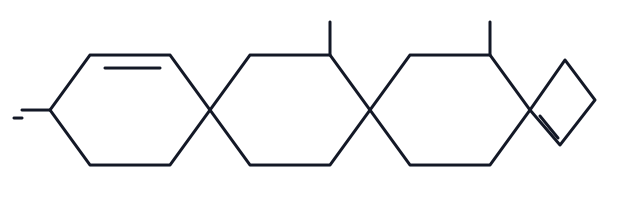
The molecules themselves are small steroid compounds. Your body makes them, they sit on your skin, and they slowly evaporate into the air around you. When someone moves into your close range, the breathing zone of a conversation, they take those molecules in. Regions of their brain that have nothing to do with deliberate thought begin running interpretations. Is this person safe, dominant, warm, interesting, or someone to keep distance from.
The window where this matters most is the first impression. The judgments a person forms in the opening seconds get quietly colored by what they took in before they could name it. That is not a love potion. It is a thumb resting lightly on the scale of a first read. I walk through that first-impression window in detail in how pheromones influence first impressions.
The Molecules
There are dozens of compounds sold under the pheromone banner. A handful do most of the actual work, and each one has its own deep dive if you want to go further than this overview.
Androstadienone (A1)
The single most studied molecule in the category. Peer-reviewed work on androstadienone links it to modest mood lift, sustained attention, and small measurable shifts in how women rate men in a room. It reads as comfort, warmth, and bonding rather than heat, which makes it a relationship-side molecule rather than a seduction one. Because that comfort read can turn a blend into a cuddle bottle, there is no A1 in any of the blends I carry. It is sold only as a pure standalone you layer yourself, in a 5 to 25 microgram trace, when the night is about closeness rather than conquest. The full mechanism is in androstadienone effects.
Androstenone
The dominance signal. At a light dose it reads as confident and present. Push the dose and it tips into aggressive or even hostile, which is why it rewards restraint. The split between it and its gentler cousin is covered in androstenone vs androstenol.
Androstenol
The friendly, social molecule. It makes a room feel a little easier when you walk in, warmer and lower stakes than androstenone. Good for group settings and anywhere a dominance read would be the wrong note. There is a full breakdown in what is androstenol.
Androsterone
The calm masculine base. Less dominant than androstenone and far less polarizing than A1, it reads as stable and masculine rather than aggressive or sedating. It is the quiet foundation a lot of blends are built on.
On the female side, the main players are the copulins, a family of compounds that appear in women’s perfumes, and estratetraenol, the proposed female counterpart to A1. What each of these is thought to signal is covered in what pheromones attract men and what pheromones attract women. And if you are wondering what any of this actually smells like on skin, that is its own question, answered in what do pheromones smell like.
What the Evidence Actually Shows
Now for the turn. Having given the skeptics their due, it is only fair to give the same honesty to the studies that survived scrutiny, because several did.
The strongest evidence is not about making a stranger fall in love. It is about measurable shifts in mood and attention. In controlled experiments, exposure to androstadienone has produced small but real improvements in mood and sustained focus in women, along with subtle physiological changes. These are not blockbuster effects. They are quiet, repeatable ones, which is exactly what you would expect from a genuine chemosignal rather than a fantasy.
There is also work on how faces get rated. In some studies, when a target molecule is present, ratings of attractiveness or warmth nudge upward compared to a control. The effect is modest and it does not overwhelm everything else a person is judging, but it is there, and it points at that first-impression thumb on the scale.
Then there is the effect I find most honest of all, because it does not even require the other person to notice anything. It is the self-effect. When you wear something you believe sharpens your presence, you carry yourself differently, and other people respond to that changed posture. Some of that is placebo, and I will not pretend otherwise, but a real confidence loop is still a real outcome. I cover that loop in the hidden confidence boost of wearing pheromones, and its usefulness for nervous first impressions in pheromones for social anxiety.
I remember the email that made all of this click for me. A customer wrote in, a genuinely shy guy who had almost not hit purchase, to say he had finally been asked out instead of doing the asking. He could not tell me whether it was the molecules or the way he stood a little straighter wearing them. Honestly, neither could I, and that is the point. The door opened. He was the one who walked through it.
So Do Pheromones Work? An Honest Synthesis
Here is where I land after years of wearing these and reading the research on both sides.
Human pheromones are real, and they are modest. They are not the hardwired triggers they are in animals, and the dedicated organ that would make them work that way is offline in us. But the olfactory pathway that replaces it is genuinely powerful, and the evidence for small shifts in mood, attention, and first-impression warmth is solid enough to take seriously.
So they tilt odds. They do not override them. A good blend opens the door and buys you a warmer opening minute, the beat of extra eye contact, the person who leans in half a second before they can tell you why. That pull is real, and it is the single strongest thing a well-made formula does. What it will not do is carry a flat conversation, manufacture attraction that has nothing underneath it, or work the same on every body, because your own skin chemistry changes how any of it reads.
That is the whole honest pitch. Pheromones are a thumb on the scale, not a hand around the throat. If you want the fuller argument on both sides, I keep it in do pheromones really work, and the specific question of whether the colognes sold today are legitimate is answered in are pheromone colognes legit.
If you have read this far and want to feel the effect for yourself rather than read about it, WOLF Original is the one I wore through ten years of sales work. It is androstenone-led with social warmth layered in, forgiving on dose, and the bottle I hand most newcomers.
Go Deeper: The Full Library
This page is the map. Each link below goes to the full territory.
How to use them
- How to apply pheromone cologne
- How to make pheromone cologne last longer
- Why your pheromones aren’t working
What to buy
The molecules
- Androstadienone (A1) effects
- Androstenone vs androstenol
- What is androstenol
- What is hedione
- What do pheromones smell like
Female signals
The effects
- The hidden confidence boost of wearing pheromones
- How pheromones influence first impressions
- Pheromones for social anxiety
- Social pheromones
Do they work?
Pheromones FAQ
Frequently asked
Do humans have pheromones? ▾
Yes, though not in the clean, hardwired way animals do. Humans produce small steroid molecules such as androstadienone and androstenone that sit on the skin and can influence how another person reads mood, warmth, or dominance. The effect is real but subtle, and it works through ordinary smell rather than a dedicated organ, which is why the science is more debated than the marketing admits.
Are human pheromones real or a myth? ▾
They are real but oversold. The idea of a spray that flips attraction like a switch is a myth, and the headline studies from the 1990s have not all replicated. What holds up is quieter: controlled research shows small, repeatable shifts in mood, attention, and first-impression ratings from specific molecules. Real chemistry, modest effect, decades of hype layered on top.
What is the vomeronasal organ and do humans use it? ▾
The vomeronasal organ is a structure in the nose that detects pheromones in many animals, wired straight to instinct centers in the brain. Humans have a tiny remnant of it, but in adults it appears vestigial: no working nerve to the brain and mostly broken receptor genes. Whatever chemosignaling humans do runs through the main sense of smell instead, not through this organ.
Do pheromone colognes actually work? ▾
They can nudge how a room reads you, but they do not guarantee anything. A well-made blend can lift a first impression, hold eye contact a beat longer, and give the wearer a real confidence loop. What it will not do is carry a flat conversation or create attraction from nothing. Think of it as a thumb on the scale, not a magic switch, and treat any product promising more as a red flag.
What are the main human pheromone molecules? ▾
The four best-known are androstadienone (A1), which reads as comfort and bonding; androstenone, which reads as dominance; androstenol, the friendly social molecule; and androsterone, a calm masculine base. On the female side, copulins and estratetraenol are the main players. Each behaves differently by dose and by the skin it sits on.
Are pheromones the same as smell? ▾
Not exactly, though in humans the two overlap. Pheromones are chemical signals meant to influence another individual, and an unscented pheromone molecule may sit near or below the threshold of conscious smell. You often will not consciously smell it, yet your brain can still register it through the olfactory system and shift your mood or read of a person before you notice anything.
Do pheromones make someone attracted to you? ▾
No, not on their own. Pheromones can tilt a first impression slightly in your favor, buying a warmer opening minute and a beat of extra interest. They do not override someone's actual preferences, consent, or the rest of what you bring to the interaction. They amplify presence and grooming that already exist. With nothing underneath, there is nothing to amplify.
Why did the menstrual synchrony study matter to this debate? ▾
The 1998 dormitory study suggesting women who live together sync their cycles was one of the early pillars of human pheromone research. It matters because later attempts to replicate it repeatedly failed, and reanalysis suggests the original effect may have been a statistical artifact. Its collapse is a big reason careful scientists stay cautious about strong human pheromone claims.
If the vomeronasal organ is offline, how do pheromones work in humans? ▾
Through the main olfactory system, the same one that smells coffee or rain. It is far more sensitive than conscious awareness suggests and routes directly into the limbic system, the brain's emotional and memory core, often before the thinking mind labels anything. So a molecule can shift your mood or attention without you consciously smelling it, no dedicated organ required.
Should I believe pheromone marketing claims? ▾
Be skeptical. The category has spent thirty years overpromising, and fake before-and-after stories are everywhere. Trust language that talks about tilting odds, first impressions, and modest shifts, and distrust anything promising a switch that makes strangers helpless. The real science is quieter and more honest than the ads, which is exactly why it is worth taking seriously.